Paint page 2

Now we can lay out the first stripe.  In a study of the pictures of the prototype Bearhawks I see the top white stripe (3 1/2" wide) runs from the center of the intake hole of the nosebowl back to the bottom of the tailpost.  The top of that stripe aligns with the bottom of the rudder.  To center the stripe on the nose bowl inlet, I measured from the centerline of the inlet up 1 3/4" (since the stripe is 3 1/2" wide) and made a mark.

A heavy piece of string was stretched from that mark on the nose bowl back to the tailpost and aligned with the bottom of the rudder.  Using a pencil, several reference marks were made along the string line.

With the first strip laid out , the remaining stripes could be measured out  (see November 2001 Bear-Traks for dimensions) and marked at each reference mark.

I used 1/2" Fineline tape for masking off the stripes.  It's a bit more expensive than regular masking tape but the crisp, clean lines it makes are worth it.  Here is a picture of the masked strips down the side of the fuselage:

Paper will be hung from the bottom stripe down to preserve the white paint on the bottom.

The starburst on the tail was also laid out and masked off:

The other bit of making to do is the "N" numbers on the fuselage side. Like on the prototypes, I went with the 12" numbers on the sides.  One of my dreams is to fly to the Bahamas some day. The 12" numbers are required for that trip.

I purchased the "N" number stencil set from Aircraft Spruce (P/N 09-00288).  These are the slanted ones but they have straight if you want.  You have to send them your "N" number and they order it from the manufacturer.  It takes a few weeks so order them in advance if you want to go this route.

The numbers come on a large sheet of  thick paper.  They are already perfectly aligned and spaced.  You just tape the whole sheet in place where you want the numbers to be and tape it along the top, creating hinge of sorts.  A cut is made between each number as shown here:

I aligned mine with the strips and just forward of the tail.  When deciding where you want the "N" numbers, do the right side first if you have the cargo door option.  The cargo door limits your "N" number location a bit unless you let the numbers run onto the door itself.

Now with all the numbers cut, but still held in alignment with the strip of tape along the top, the backing from each number is slowly stripped off from the top - down while smoothing the number down onto the fuselage side with a squeegee.

Here are the "N" number stencils in place:

OK, it's time to put some Red paint on.   Since the white paint has been on for a little over a week, the Poly Fiber book recommends cleaning it thoroughly and then spraying a mist coat of 100% thinner on first, to soften the white paint and prepare for the Red.

To create nice clean stripes and "N" numbers, its best to spray a coat of the underlying paint (in this case white) on along each stripe and "N" number.  This seals the tapes and will create a really clean line between the colors.

Once the white paint was tacky, I went on with one mist coat, followed by 3 good solid coats.of Red.  After the Red had dried to a tack free condition (about 1 hour) the masking tape and paper was all carefully removed.  

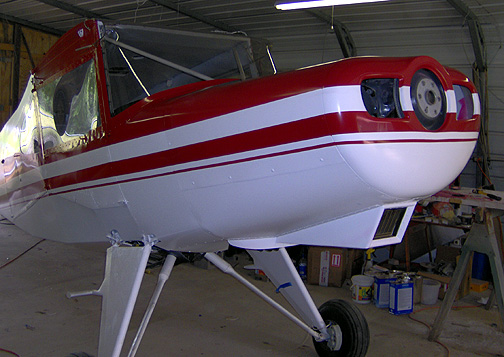
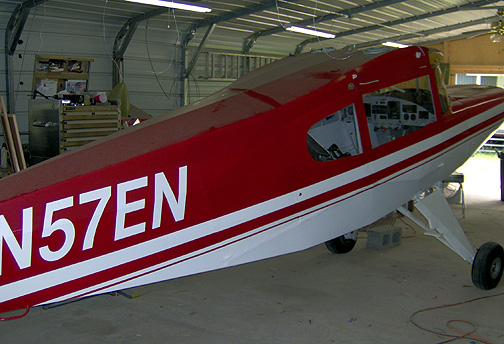
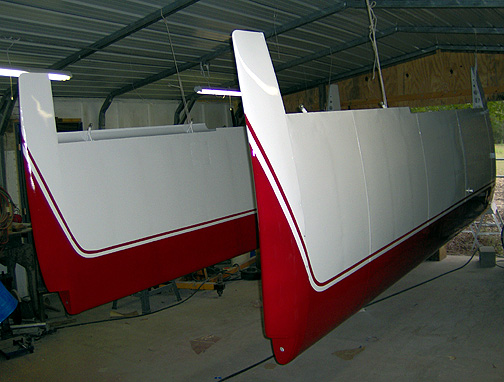
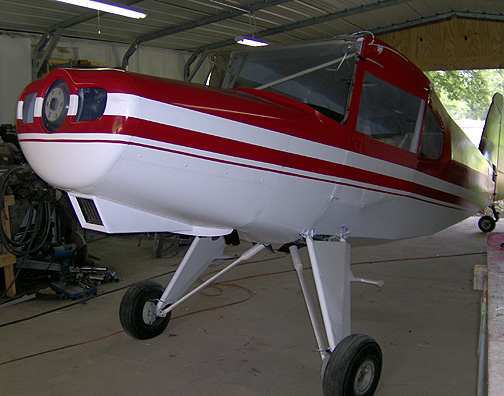
I am very happy with the results.  Here are some pictures:

Here you can see why the cargo door kind of limits your "N" number location:

I guess you could let the "N" number go onto the cargo door but it would be a bit more complicated.

I'm very happy with way this came out.  After it dries for about 2 weeks, I'll come back and use a polishing wheel and some fine rubbing compound, then Carnuba wax to really bring out the shine. 

Click here her for Paint page 3