Fabric Covering page 2

Next, the same thing was done on the right side of the fuselage, again with the fabric hanging about 3" over the left, top stringer:

Sorry for the blurry picture - camera started acting up.

Now you can see why the single seam can only be accomplished if you have the cargo door option.  This fabric is attached along the top, left stringer and as you can see, it is not wide enough to cover all the way down to the bottom longeron.  In fact, it only reaches the bottom longeron up until you get to the aft end of the cargo door.  Lucky for us, we can cut it at that point and wrap it inside the cargo door flange, then cover the bottom part of the cargo door with a separate piece.

Once again, a pencil was used to draw a line on the fabric along the top, left stringer.  This line represents the seam that must be sewn to put the left and right sides together.  

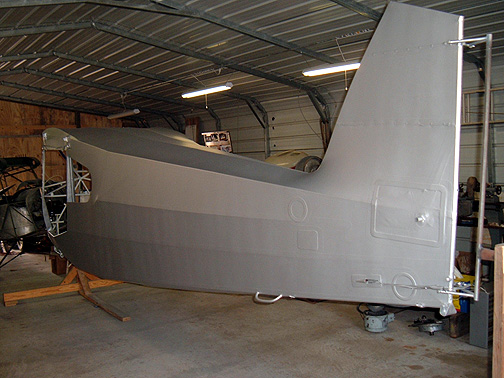
The seam stops right at the base of the vertical fin where the little curved tube is.  Rather than run the seam all the way up the vertical fin, the fabric will be wrapped and glued to the vertical fin since it is a primary structure.

As per the Poly Fiber book, you cannot simply wrap and glue the two halves to the stringer because it is not a primary structure.  A seam must be sewn using the approved Poly Fiber thread.  

This is where it helps to have a loving and supportive wife who actually knows how to sew and enjoys it.  Here is my wife Michelle, sewing the fuselage seam for me:

Note the large spool of Poly Fiber thread duct taped to the sewing machine.  It wouldn't fit on the spool holder.  

The 2 halves of the fuselage fabric were pined together with the pencil lines aligned.  Michelle then sewed it together using a "Modified Folded Fell Seam" as shown in Appendix B of the Poly Fiber Manual (Revision No. 20 - July 2001).

Before installing the main fuselage fabric, the bottom fabric was cut and glued in place as shown here:

In the picture above, the fabric was cut with a 3" overhang and glued in place to the bottom longerons.  It was then trimmed to just wrap around the bottom longeron and final glued in place before installing the main fuselage fabric.

Before installing the envelope, we will need to establish the point where the rudder cables will exit the fabric back near the tailpost.  A hole must be made in the fabric at the exit point and it would  be nice to keep the hole as small as possible.  To accomplish this, the rudder was attached and the rudder cables were ran and attached to the rudder.  The measurements were then taken like this:

A straightedge was held on the top and bottom longerons to simulate the fabric.  It was slid along the longerons until it just made contact with the rudder cable.  That point was then measured from the tailpost and the measurement was written down.  A measurement was then taken at the same location but from the bottom longeron up to the rudder cable and that measurement was written down.  The same was done for the right side of the fuselage.  Once the fabric is installed and all shrunk to its final place, we can accurately make the holes for the rudder cable transition.

Now the envelope that we made can be installed and clamped in place with the seam running exactly along the top, left stringer full length:
As previously stated, the seam ends (or begins) right at the point where the vertical fin meets the fuselage top stringers (on the little curved tube).  

Once it was aligned to our liking, it was time to fit the fabric to the vertical fin and glue it in place.  Starting with the right side, a series of cuts (slits) were made as shown below to allow the fabric to lay down on the inside curve and wrap around the tube:

The fabric was pulled snug and glued around the curved tube as show here:

Click here to go to Fabric Covering page 3

Click here to go Home